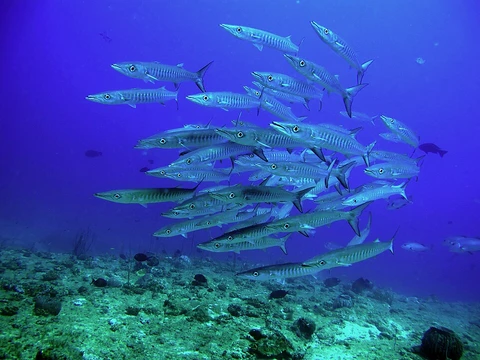
Pelagic fish
Pelagic fish live in open water, neither near bottom nor shore.

Wikipedia / Wikimedia Commons
Pelagic fish inhabit the pelagic zone of ocean or lake waters, neither close to the bottom nor near the shore, in contrast with demersal fish that live on or near the bottom and reef fish associated with coral reefs. The marine pelagic environment is the largest aquatic habitat on Earth, occupying 1,370 million cubic kilometres, and is the habitat for 11% of known fish species. Pelagic fish range from small coastal forage fish, such as herrings and sardines, to large apex predator oceanic fishes, such as bluefin tuna and oceanic sharks, and are usually agile swimmers capable of sustained cruising on long-distance migrations.
- habitat
- Pelagic zone of oceans and lakes
- environment_size
- 1,370 million cubic kilometres (330 million cubic miles)
- species_percentage
- 11% of known fish species
- depth_range
- Surface to 200 m (epipelagic zone) and beyond
- examples
- Herrings, sardines, bluefin tuna, oceanic sharks, ocean sunfish
- key_feature
- Agile swimmers with streamlined bodies; many school; some solitary
Lore & Background
Pelagic fish can be divided into coastal (inshore) fish and oceanic (offshore) fish. Coastal pelagic fish inhabit the relatively shallow and sunlit waters above the continental shelf, while oceanic pelagic fish inhabit the vast and deep waters beyond the continental shelf, though they may also swim inshore. Many pelagic fish swim in schools weighing hundreds of tonnes, while others, such as the large ocean sunfish, are solitary. There are also freshwater pelagic fish in some larger lakes, such as the Lake Tanganyika sardine.
Epipelagic fish inhabit the uppermost layer of the water column, from sea level down to 200 m, also called the sunlit zone or photic zone. This zone is well lit, well mixed, and oxygenated, but lacks habitat variation, supporting less than 2% of the world's known fish species. Epipelagic fish can be divided into small forage fish and larger predator fish; both often have streamlined bodies and countershaded silvery colours that reduce visibility. Forage fish school and filter feed on plankton, while predators use vision to prey on zooplankton or smaller fish.
Epipelagic fish are fascinated by floating objects, aggregating around drifting flotsam, rafts, jellyfish, and floating seaweed. These objects provide visual stimulus and may offer refuge for juvenile fish. Fishermen use this behavior with fish aggregating devices (FADs) to capture tuna and other species. Coastal epipelagic fish are among the most abundant in the world, thriving in inshore waters with high productivity from upwelling and nutrient runoff.
Reader's Guide
Pelagic fish are significant as they form the most valuable fisheries in the world, with forage fish occurring in huge numbers and larger predator fish sought after as premier food fish. The epipelagic zone, though supporting less than 2% of known fish species, is abundant in numbers, and these fish are crucial to marine food webs. Their streamlined bodies and migratory capabilities allow them to traverse vast distances, linking different oceanic regions. The use of fish aggregating devices demonstrates how human fishing practices leverage natural behaviors, impacting both coastal and oceanic fisheries. The distinction between coastal and oceanic pelagic fish highlights the ecological diversity within open-water habitats, from nutrient-rich inshore areas to the deep, clear waters of the open ocean. Understanding pelagic fish is essential for managing global fish stocks and maintaining the health of the largest aquatic habitat on Earth.
Did You Know?
- About 90% of the total ocean water volume is below 100 metres, and 75% is below 1,000 metres.
- Epipelagic fish inhabit the uppermost 200 metres of the water column, the sunlit zone where photosynthesis occurs.
- Many pelagic fish are countershaded with silvery scales that function as small mirrors, reducing visibility from predators.
- Some of the largest epipelagic fishes, such as the basking shark and whale shark, are filter feeders.
Frequently Asked Questions
What are pelagic fish?
Pelagic fish are species that inhabit the open water column of oceans and lakes, staying well away from both the seafloor and the shoreline. They occupy the vast middle region of aquatic environments rather than clinging to the bottom or hugging coral reefs.
Where exactly do pelagic fish live?
They roam the pelagic zone, which stretches from the surface down to roughly 200 meters (the epipelagic zone) and even deeper. This open-water habitat spans an enormous 1,370 million cubic kilometres, making it the largest aquatic environment on the planet.
What types of fish count as pelagic?
The group spans a huge range, from tiny schooling forage species like herrings and sardines up to massive apex predators such as bluefin tuna, oceanic sharks, and the ocean sunfish. Together they represent about 11% of all known fish species.
What physical traits do pelagic fish share?
Most are agile, streamlined swimmers built for sustained cruising through open water rather than short bursts near cover. Many travel in large schools, though some, like certain sharks and the ocean sunfish, prefer to hunt or drift alone.
How are pelagic fish different from demersal or reef fish?
While demersal fish live on or near the ocean floor and reef fish are tied to coral structures, pelagic fish are defined by their life in the open water column between the surface and the bottom. This freedom from a fixed substrate shapes their body shape, schooling behavior, and long-distance migration patterns.
More in Fish And Marine Life 1-23
Spotted an error? Know more?
This is a living reference — every entry is fact-audited, and reader corrections feed straight into our audit queue. Suggest an edit · See this site's audit record