Atlantic cod
A heavily fished apex predator of the North Atlantic.
The Atlantic cod (*Gadus morhua*) is a member of the fish family Gadidae and is heavily harvested for human consumption. In the western Atlantic, it ranges north of Cape Hatteras, North Carolina, and around both Greenland coasts and the Labrador Sea; in the eastern Atlantic, it appears from the Bay of Biscay up to the Arctic Ocean, including the Baltic, North, and Barents Seas, the Sea of the Hebrides, and waters near Iceland. This fish can reach 25 years of age, typically growing to 100–140 cm (40–55 in), though specimens over 180 cm (70 in) and 50 kg (110 lb) have been recorded. Sexual maturity occurs between ages 2 and 8, depending on the population and time period. Its coloration is brown or green with spots on the back, fading to silver underneath, and a clear stripe runs along its lateral line, which senses vibrations. It lives from coastal shorelines down to 300 m (1,000 ft) along the continental shelf.
For about a thousand years, northern European fishers pursued Atlantic cod across the North Atlantic to North America. It underpinned the U.S. and Canadian fishing economy until 1992, when Canada banned cod fishing. Several cod stocks collapsed in the 1990s—declining by over 95% of their historical maximum biomass—and have not fully recovered even after fishing stopped. The loss of this apex predator triggered a trophic cascade in many areas, and numerous other cod stocks remain at risk. The species is listed as vulnerable on the IUCN Red List (based on a 1996 assessment the IUCN notes needs updating), though a 2013 assessment covering only Europe found it had rebounded there and was relabeled least concern. Dry cod can be made into unsalted stockfish or cured salt cod (clipfish).
Taxonomically, the Atlantic cod is one of three *Gadus* species, alongside Pacific cod and Alaska pollock. Many fish called "cod" are not in the genus *Gadus*, though some belong to the family Gadidae.
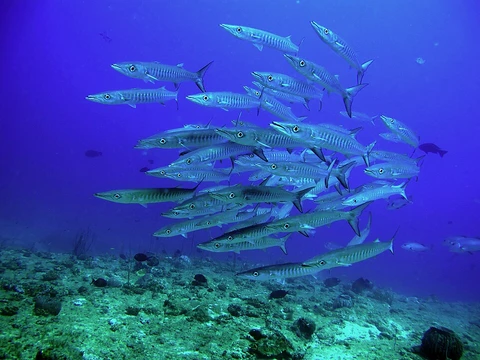
Atlantic cod are shoaling fish, forming large, size-structured groups. Larger individuals act as scouts, guiding the shoal’s direction, especially during post-spawning migrations inshore to feed. They feed actively while migrating, and shoal structure shifts when food is found. Shoals are generally leaderless, with equal status and resource distribution among fish, though some studies suggest leading fish gain feeding advantages. One study of a migrating shoal found that lar
- Scientific name
- Gadus morhua
- Family
- Gadidae
- Maximum lifespan
- 25 years
- Typical length
- 100–140 cm (40–55 in)
- Maximum recorded size
- 180 cm (70 in) and 50 kg (110 lb)
- Sexual maturity
- Between ages 2 and 8
- IUCN status
- Vulnerable (1996 assessment, noted as needing update)
Lore & Background
Atlantic cod are a shoaling species, moving in large, size-structured aggregations. Larger fish act as scouts and lead the shoal's direction, particularly during post-spawning migrations inshore for feeding. Studies show that larger scouts consume a more variable, higher quantity of food, while trailing fish have less variable diets. Fish distribution throughout the shoal seems dictated by size, with smaller lagging fish benefiting from social facilitation.
As apex predators in the Baltic, adult cod are generally free from predation concerns, though juvenile cod may be prey for adult cod, which practice cannibalism. Juvenile cod make substrate decisions based on predation risk, preferring cobble for safety. Heavy fishing in the 1990s removed cod as a major predator, leading to trophic cascades and increased abundance of species such as American lobsters, crabs, and shrimp.
Atlantic cod feed on fish such as herring, capelin, and sand eels, as well as squid, mussels, clams, and crustaceans. Small cod primarily eat crustaceans, while large cod primarily eat fish. Cannibalism accounts for 1–10% of stomach contents in some regions. Cod larvae are altricial, relying on a yolk sac until mouth opening at about 24 degree days.
Reader's Guide
The Atlantic cod has been fished for a thousand years by north European fishers who followed it across the North Atlantic to North America. It supported the US and Canadian fishing economy until 1992, when the Canadian Government implemented a fishing ban. Several cod stocks collapsed in the 1990s, declining by more than 95% of maximum historical biomass, and have failed to fully recover even with cessation of fishing. This absence of the apex predator led to trophic cascades in many areas. Many other cod stocks remain at risk. The Atlantic cod is labelled vulnerable on the IUCN Red List, per a 1996 assessment that the IUCN notes needs updating. A 2013 assessment covering only Europe shows the Atlantic cod has rebounded there and been relabelled least concern. The species' role as a major predator and its economic importance make its management a critical issue for marine ecosystems and fisheries.
Did You Know?
- Atlantic cod can live up to 25 years and grow to over 180 cm (70 in) and 50 kg (110 lb).
- Juvenile cod prefer cobble substrate to reduce predation risk, and will hide in kelp if cobble is unavailable.
- A decrease of only 2.5 °C (5 °F) caused a 15–30% increase in metabolic rate in cod.
- In the northern North Sea, cannibalism accounted for 10% of stomach contents in cod larger than 10 cm.
Frequently Asked Questions
Who is Atlantic cod?
The Atlantic cod (Gadus morhua) is a member of the Gadidae family that inhabits cold North Atlantic waters, stretching from the Bay of Biscay up through the Barents and Arctic Seas, and south to Cape Hatteras. It is one of the most historically significant fish in human culture, particularly across Europe and North America.
What is Atlantic cod's role in its ecosystem?
As a heavily fished apex predator, the Atlantic cod occupies the top of North Atlantic marine food webs, preying on smaller fish and invertebrates. Its presence helps keep populations of species below it in check, making it a keystone player in the health of those ecosystems.
How does Atlantic cod's story end?
Decades of intensive commercial harvesting drove several major Atlantic cod stocks to collapse, most dramatically the 1992 moratorium off Newfoundland that upended an entire regional economy. Some populations are slowly rebuilding under strict quotas, but the fish that once sustained coastal communities for centuries remains critically vulnerable.
Why is Atlantic cod important?
The Atlantic cod has anchored human food supply and maritime economies for hundreds of years, supporting fishing towns from Iceland to the Grand Banks. Ecologically, its role as an apex predator shapes the structure of whole North Atlantic marine communities.
How big and old can Atlantic cod get?
Most individuals grow to 100–140 cm and live up to roughly 25 years, though rare specimens over 180 cm and 50 kg have been recorded. They typically reach sexual maturity somewhere between their second and eighth year of life.
More in Fish And Marine Life 1-23
Spotted an error? Know more?
This is a living reference — every entry is fact-audited, and reader corrections feed straight into our audit queue. Suggest an edit · See this site's audit record