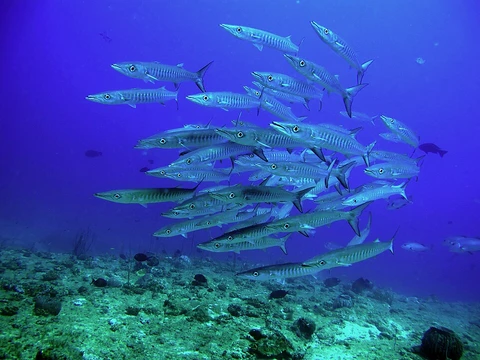
Atlantic herring
One of the world's most abundant fish, forming massive schools.
Atlantic herring (Clupea harengus) is a fish in the family Clupeidae, one of the most abundant fish species in the world. It is found on both sides of the northern Atlantic Ocean, congregating in large schools, and has long been an important part of the economy of New England and the Atlantic provinces of Canada.
- scientific_name
- Clupea harengus
- max_length
- 45 cm (18 in)
- max_weight
- 1.1 kg (2.4 lb)
- typical_lifespan
- 12–16 years after maturity
- sexual_maturity
- 3–5 years
- key_habitat
- North Atlantic waters, including Gulf of Maine, Gulf of St. Lawrence, North Sea
- known_for
- Forming immense schools up to 4 cubic km containing billions of fish
Lore & Background
Atlantic herring have a fusiform body and use gill rakers to filter zooplankton and phytoplankton from the water. They are fragile fish with large, delicate gill surfaces and scales that can be easily stripped away. They have retreated from many estuaries due to water pollution, though they have returned to some cleaned-up estuaries; their larvae indicate cleaner, more-oxygenated waters.
Herring reach sexual maturity at 3 to 5 years old and have a life expectancy of 12 to 16 years once mature. They spawn in estuaries, coastal waters, or offshore banks, with external fertilization: females release 20,000 to 40,000 eggs, and males release milt. The fertilized eggs sink and adhere to gravel or weed, maturing in 1–3 weeks depending on water temperature, which must stay below 19°C.
Atlantic herring are obligate schoolers, forming groups of thousands to millions. Schools can occupy up to 4.8 cubic km with densities of 0.5 to 1.0 fish per cubic meter. They have excellent hearing and can react quickly to evade predators. Schools keep a distance from moving divers or predators, forming a vacuole visible from the air.
Reader's Guide
Atlantic herring are ecologically and economically significant as a dominant converter of zooplankton into fish, consuming copepods, krill, and small fish, while serving as a central prey item for seals, whales, cod, and other larger fish. Their massive coastal schools have made them a cornerstone of fisheries in New England and Atlantic Canada. The species shows very little genome-wide genetic differentiation, but a few hundred loci are associated with adaptation to salinity, spawning season, and local light and temperature conditions. A distinct subspecies, the Baltic herring (Clupea harengus membras), is recognized in the Baltic Sea, where fisheries have been at unsustainable levels since the Middle Ages; overfishing and cooling during the Little Ice Age led to the near-extinction of an autumn-spawning population, replaced by a spring-spawning one. The Baltic herring was elected the national fish of Estonia in 2007. Herring schools are among the most spectacular in the ocean, and their precise spatial arrangement allows constant cruising speed, though the function of schooling remains debated.
Did You Know?
- Atlantic herring can grow up to 45 cm (18 in) and weigh up to 1.1 kg (2.4 lb).
- Herring schools have been measured up to 4 cubic km (0.96 cu mi) in size, containing an estimated four billion fish.
- The Baltic herring (Clupea harengus membras) is considered a distinct subspecies and was elected the national fish of Estonia in 2007.
- Herring have excellent hearing and can form a vacuole around a moving scuba diver or predator, visible from a spotter plane.
More in Fish And Marine Life 1-23
Spotted an error? Know more?
This is a living reference — every entry is fact-audited, and reader corrections feed straight into our audit queue. Suggest an edit · See this site's audit record