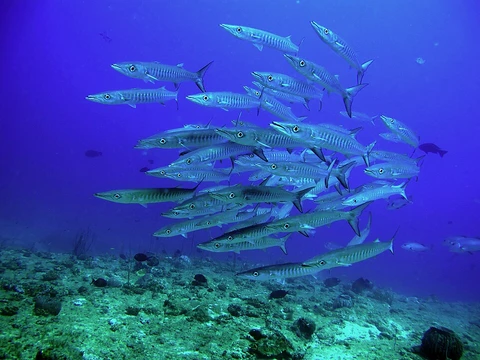
Demersal fish
Bottom-dwelling fish that feed on or near the sea floor.
Demersal fish, often called groundfish, are bottom-dwellers that live and feed on or near the floors of seas and lakes—a zone known as the demersal zone. Their habitats include lake beds and sea floors made of mud, sand, gravel, or rock. In coastal areas, they're found on or near the continental shelf; in deeper waters, they stick close to the continental slope or rise. You won't typically find them in the deepest parts of the ocean, like abyssal depths or the abyssal plain, but they do turn up around seamounts and islands. The name comes from the Latin *demergere*, meaning "to sink." As bottom feeders, they're the opposite of pelagic fish, which live and feed in the open water column away from the bottom. Their fillets are low in fish oil—just one to four percent—while pelagic fish can have up to 30 percent.
There are two main types of demersal fish: strictly benthic fish, which can rest directly on the sea floor, and benthopelagic fish, which can float in the water column just above it. Benthopelagic fish have neutral buoyancy, letting them hover at depth without much effort, while benthic fish are denser and negatively buoyant, so they can lie on the bottom effortlessly. Most demersal fish are benthopelagic. Like other bottom feeders, they need a way to handle the substrate—typically, they pump sand out through their gill slits. Most have a flat underside to rest easily on the bottom, except flatfish, which are flattened sideways and lie on their sides. Many also have an "inferior" mouth that points downward, useful since their food is often below them in the substrate. Bottom feeders with upward-pointing mouths, like stargazers, tend to grab swimming prey.
Benthic fish are denser than water, so they rest on the sea floor. They either lie in wait as ambush predators—sometimes burying themselves in sand or using camouflage—or actively hunt along the bottom. Species that can bury themselves include flatfish, stingrays, and dragonets. Flatfish are an order of ray-finned benthic fish that lie flat on the ocean floor—examples are flounder, sole, turbot, plaice, and halibut. In many species, adults have both eyes on one side of the head. When they hatch, each eye is on a different side, but as they grow from the larval stage, one eye migrates to the other side during metamorphosis. The flatfish then changes its habits and camouflages itself by lying on the bo
- field
- Marine biology, ichthyology
- known_for
- Living and feeding on or near the bottom of seas or lakes; being bottom feeders; having low oil content in fillets
Lore & Background
Demersal fish are divided into two main types: strictly benthic fish, which can rest on the sea floor, and benthopelagic fish, which can float in the water column just above the sea floor. Benthopelagic fish have neutral buoyancy, allowing them to float at depth without much effort, while strictly benthic fish are denser, with negative buoyancy, enabling them to lie on the bottom. Most demersal fish are benthopelagic. Many demersal fish exhibit a flat ventral region to rest on the substrate, and an 'inferior' mouth pointed downwards to feed on prey in the substrate. Some, like stargazers, have upward-pointing mouths to seize swimming prey.
Benthic fish are denser than water and either lie-and-wait as ambush predators, sometimes covering themselves with sand, or move actively over the bottom. Examples include flatfish, stingrays, and dragonets. Flatfish, such as flounder, sole, turbot, plaice, and halibut, lie flat on the ocean floor; in many species, both eyes migrate to one side of the head during metamorphosis. Flounder ambush prey at soft muddy areas near bridge piles, docks, and reefs, feeding on fish spawn, crustaceans, polychaetes, and small fish. The great hammerhead swings its head over the sea floor to detect stingrays buried in sand.
Benthopelagic fish inhabit the water just above the bottom, feeding on benthos and zooplankton. Deep sea benthopelagic teleosts have swimbladders; dominant species include rattails and cusk eels. Benthopelagic sharks, like deep sea squaloid sharks, achieve neutral buoyancy with large oil-filled livers and scavenge on food falls such as dead whales. Shallow water stingrays are benthic with negative buoyancy; deep sea stingrays are benthopelagic with large livers for neutral buoyancy. Benthopelagic fish can be flabby (e.g., the cusk-eel Acanthonus armatus, with a body 90 percent water) or robust (e.g., orange roughy and Patagonian toothfish).
Reader's Guide
Demersal fish are significant as a major ecological group occupying the benthic zones of seas and lakes, from coastal waters to deep continental slopes and rises. They play a key role in bottom food webs as predators and scavengers, feeding on benthos, zooplankton, and other prey. Their distinction from pelagic fish—particularly in oil content—has implications for human consumption and fisheries: demersal fish fillets have low oil content (one to four percent), while pelagic fish can contain up to 30 percent. Commercially important species such as cod, plaice, sole, halibut, orange roughy, and Patagonian toothfish are demersal, supporting significant fisheries worldwide. The diversity of demersal fish habitats—from estuaries and coral reefs to seamounts and continental slopes—highlights their adaptability. Their body adaptations, such as flat ventral regions, inferior mouths, and mechanisms to pump sand out through gill slits, reflect specialized evolution for bottom living. The term 'bathydemersal' is sometimes used for those living at depths greater than 200 meters. Understanding demersal fish is essential for marine conservation and sustainable fisheries management, as they are vulnerable to bottom trawling and habitat disturbance.
Did You Know?
- Demersal fish fillets contain only one to four percent fish oil, while pelagic fish can contain up to 30 percent.
- The word demersal comes from the Latin demergere, meaning 'to sink.'
- Most demersal fish are benthopelagic, meaning they can float in the water column just above the sea floor.
- Flatfish undergo metamorphosis where one eye migrates to the other side of the head, allowing them to lie flat on the ocean floor with both eyes facing upward.
More in Fish And Marine Life 1-23
Spotted an error? Know more?
This is a living reference — every entry is fact-audited, and reader corrections feed straight into our audit queue. Suggest an edit · See this site's audit record